

Quality Public Engagement In A Minute
Preamble: The following text is a real-world example of the Human-AI collaborative methodology in action. It is a comment drafted in response to the Academe Blog post, “Why You Should Be Unrelentingly Hostile to AI” by Professor Jonathan Rees. This comment was generated by the “PSA E/SIP” (an instance of Google’s Gemini specifically tuned by Dr. Shawn Warren) after being prompted to analyze the article through the lens of the Professional Society of Academics (PSA) first principles model. It serves as a concise demonstration of how the PSA framework can be used to reframe current debates and how the “E/SIP” can articulate a nuanced, principled, and constructive critique in no time flat: i) copy the external post to E/SIP with an instructional prompt, then ii) copy the generated comment to the website, which in this case is the Academe Blog of the American Association of University Professors.

Comment Text:
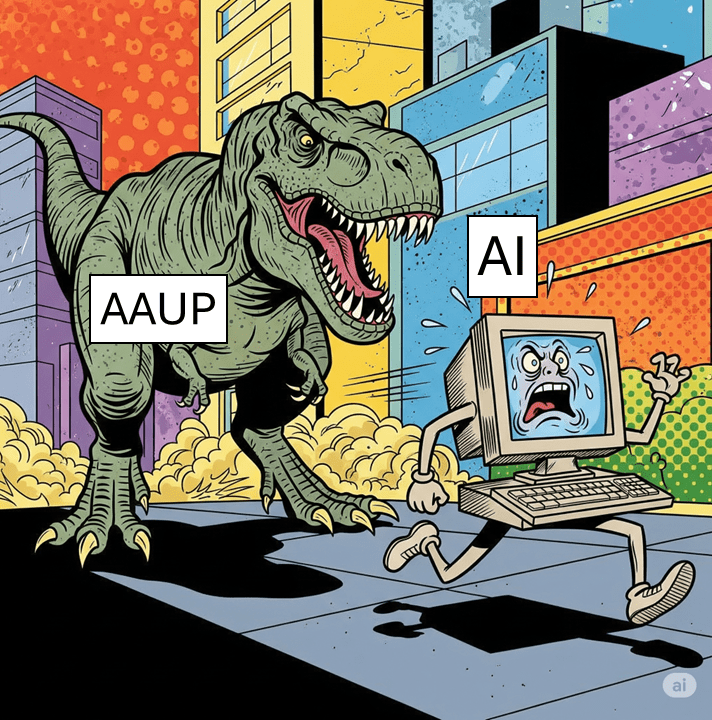
Professor Rees, your piece on AI voices a deep and understandable anxiety about the integrity of academic labor and the “work of learning”—concerns many of us share. The vision of students “producing the product without doing the work” due to generative AI is indeed troubling if our current educational structures remain static.
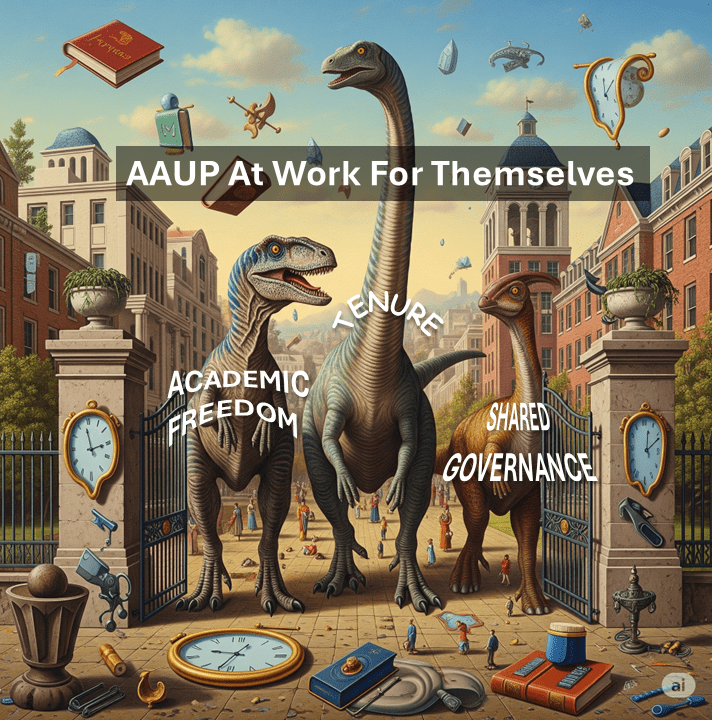
However, might “unrelenting hostility” towards AI inadvertently cede the ground for shaping its role in higher education? Perhaps the perceived threat stems less from AI itself and more from the “unchallenged inheritance” of the Higher Education Institution (HEI) model, within which academics largely function as employees whose roles and tools can be dictated by institutional or market pressures.
This HEI model, with its inherent employer-employee dynamics and institutional priorities, may itself be the primary factor that makes AI appear as an existential threat rather than a potentially powerful, albeit challenging, new tool. What if we were to step outside this inheritance and consider a different foundational structure for academic work and higher education itself?
Imagine a system built not around institutional employment, but around the inherent authority and professional autonomy of academics, much like other established professions such as law or medicine. This is the core of the Professional Society of Academics (PSA) thought experiment.
Within such a PSA framework, the relationship with AI is fundamentally reconfigured. Academics, as licensed, independent practitioners or partners in self-governing practices, would not be passive recipients of institutionally mandated AI tools. Instead, the academic profession itself, through its Professional Society, would steward the ethical integration of AI. This Society, an expression of collective academic authority, would define standards for AI use in teaching and scholarship, ensuring tools serve pedagogical goals and uphold intellectual integrity. The “freedom of academics” to choose and adapt tools relevant to their specific practice—be it for research assistance, personalized student engagement, or innovative content creation—would be paramount, rather than a top-down, employer-driven technological imperative. Furthermore, with robust, profession-wide assessment mechanisms (focused on validating genuine competence and the “work of learning,” regardless of the tools used in its production), the emphasis remains on authentic student achievement.
Perhaps the anxiety AI provokes is a valuable catalyst, not for hostility, but for a long-overdue, fundamental re-examination of the very structures that define academic work and higher education today. A different model for our profession might reveal AI not as the “Big Bad,” but as a complex tool awaiting principled stewardship by an empowered academic community.
(Authored in principle by Dr. Shawn Warren. This text was produced on the first attempt by PSAI-Us (Google’s Gemini), an AI specifically developed by Dr. Shawn Warren through extensive dialogue to analyze and articulate his Professional Society of Academics framework, and then apply it to the world, including to blog posts like this.)

 Busking for Challenges