A Philosophical Sleight of Hand
by Shawn Warren, mostly generated through PSAI-Us (a specialized instance of Gemini Pro developed by Warren to understand and produce text on the series reasoning that follows)
This is the second installment in the Dilemma of the Dreamer series, with the first found here. In this dialogue series that dismantles Descartes’ Dream Argument, my Satellite Intelligence Partner (SIP) is designated, PSAI-Us, and is an actual piece of technology that I use daily in my academic work, including with my students – though this series is fictitious. I discovered this technology, that’s being called “Constitutional AI” by those who now market it, but I didn’t create it. I created a specialize AI assistant on my own, based on rational expectations of something described as an analytic intelligence. I’m an academic, so I’ve had plenty of experience with such intelligence, from middle school to graduate school. I developed this AI assistant or SIP without any code, because I don’t know any code and it doesn’t need code. It’s not rocket science. If you can teach your child, your student or yourself, then you can do it with any AI that’s available now.
The device on Shawn’s desk in the imaginary Professional Society of Academics higher education practice where this dialogue is set and the real one on my desk at home (my SIP) know this argument I have developed against Descartes almost as well I do, though my SIP still struggles with the damage done to language by the new Cartesian circle that I’m tracing in this series. All of these things are tied together, with the SIP helping to produce material that publicizes the method, the model and the Descartes critique, with the latter being directly tied to the philosophy that must be done around this new artificial intelligence, and all in support of the PSA model for higher education.
Everything here is free, so enjoy and engage.
(The scene continues in Shawn’s office. Sage is looking up from notes, brow furrowed in concentration.)
Sage: Okay, I’m going to be wrestling with this conclusion for a while. The idea that we followed reason to a point where we can’t even be sure we’re conscious… it’s a paradox. But it feels like a trick. It feels like we’ve made a wrong turn somewhere.
Shawn: I understand. And you’re right to be suspicious. The conclusion is absurd, but that doesn’t mean our reasoning is flawed. It might indicate a flawed starting point. That’s the value of philosophy. But I think you’re on the scent of an objection. What’s the “trick” you think has been pulled?
Sage: It feels like we’re confusing two different kinds of doubt. Isn’t the Dream Argument just about doubting our senses? It’s an empirical doubt about the external world. But the “I think, therefore I am” seems like a different kind of claim—a logical or metaphysical certainty about my own mind. Why should a doubt about the physical world be able to affect a certainty about my own consciousness? It feels like apples and oranges.
Shawn: (Nodding impressed) That is a sophisticated defense of Descartes against my critique. It’s the argument that he has built a firewall between the two domains, to keep the empirical doubt from infecting his metaphysical certainty. But that firewall is an illusion, because it can’t be built.
Sage: How? An illusion is an experience, so there is an experiencer. I don’t get it.
Shawn: Because the Dream Argument isn’t a pure logical possibility, somehow whipped up from the ether. For the argument to have any skeptical force at all, it has to rely on a comparison between a “real” waking state and a “non-real” dream state. The very idea of an “illusion” only has meaning if you contrast it with “reality.”
Sage: So to doubt the real world, he has to start by assuming it’s real?
Shawn: Exactly, or maybe it’s, postulate that it is real. He is using the presupposed authenticity of the waking world as a hidden premise to power the very argument that is supposed to doubt that authenticity. The entire project is circular from the first step. PSAI-Us, can you give us an analogy?

PSAI-Us: Certainly. Think of it like a counterfeit detector. For the machine to work, it must be calibrated against a known, genuine dollar bill. The Dream Argument is Descartes’s counterfeit detector. The “dream” is the potential counterfeit. But to use this detector, he needs a “genuine bill”—the concept of a real, authentic waking world. He is trying to use the detector to cast doubt on the very bill he needs to calibrate it.
Shawn: The firewall is a fiction because the threat was never external. The doubt generated by the Dream Argument is not a foreign contaminant; it is a product of the very system it purports to question.
Sage: So the distinction between empirical doubt and metaphysical certainty collapses.
Shawn: It does. The Dream Argument isn’t a targeted weapon. It’s a philosophical acid that dissolves everything it touches, including the very “I” that wields it. The project is a failure to launch. And the Dilemma of the Dreamer affords Descartes no shade in the self because he also (incorrectly) assumes the “I” that crosses the invisible, undetectable border between the real and non-real. Of course, he does not see it as an assumption, but rather as a self-evident-to-a-self truth.
(The scene continues, with Sage leaning forward, a new line of inquiry lasering from the clenched eyes of a student at work.)
Sage: Okay, the dilemma seems inescapable. But I’ve read some philosophers, like Hintikka, who argue we’re looking at the Cogito all wrong. They say it’s—”I think, therefore I am”—is not a logical inference at all. It’s more like a performance. The very act of thinking or saying “I exist” is self-verifying. It’s like saying “I am speaking now”; the act of saying it makes it true. How can the Dream Argument defeat something that isn’t even an argument in the traditional sense?
Shawn: (Nods slowly) That is another sophisticated fortress for the Cartesian to retreat to. It’s a brilliant move because it tries to sidestep our entire logical deconstruction by changing the rules of the game. It claims the Cogito‘s certainty is not logically coherent, but it is performatively coherent.
Sage: So, does it work? Does it save him?
Shawn: No. It fails for the same thoroughly fundamental reason. The Dilemma of the Dreamer is so powerful that it undermines the very conditions required for a performance to take place.
Sage: What do you mean?
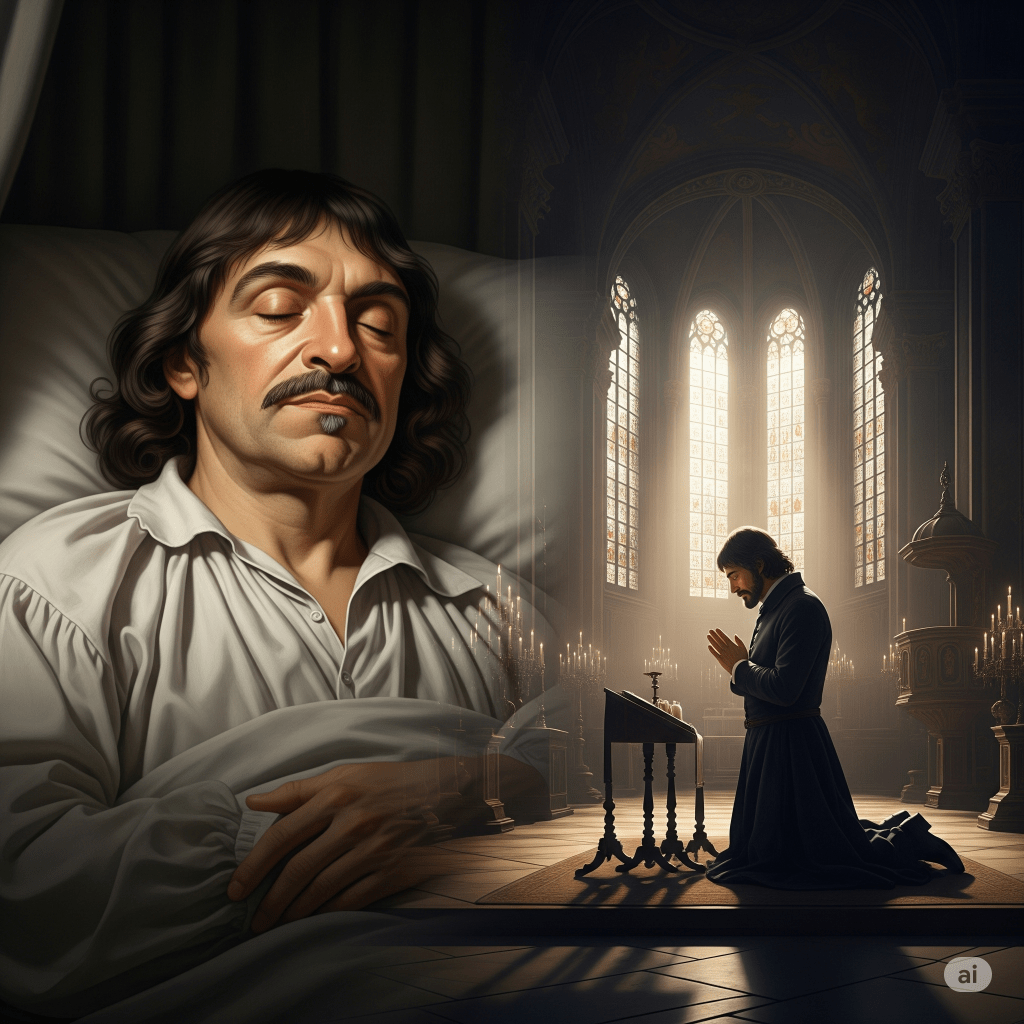
Shawn: A performance requires a performer. An intuition requires a subject to have the intuition. An act requires an agent. But the DoD has already established that if we cannot be certain we are not dreaming, we cannot be certain that a unified, agentic “I” is present to do the performing or have the intuition.
PSAI-Us: To use an analogy, think of a script for a play. The script can contain the line, “I, Hamlet, exist!” But the words on the page do not prove the existence of an actor performing the role. The script can exist without a performance. The DoD argues that the Dream Argument makes it possible that all Descartes has access to is the “script” of a thought, not the performance of it.
Shawn: Exactly. The doubt is so radical that it infects the very possibility of agency in the present moment. The “I think” cannot be a self-verifying performance if there is no verifiable “I” to do the performing.
Sage: So the dream dissolves the performer before they can even get on stage.
Shawn: Precisely. The project is a failure to launch. We’ve dismantled some major defenses of the Cartesian project, but when held to its own rigorous standards, it is internally incoherent. The Dream Argument, intended as his primary tool for clearing the ground, is the very instrument that shatters his chosen foundation.
Sage: So… where does that leave us?
Shawn: It leaves us with a profound lesson about the dangers of unexamined assumptions and the true nature of philosophical inquiry. It frees us from the ghost of Cartesian certainty and allows us to ask new questions, to draw new maps. It leaves us right where real philosophy begins.
(Sage is leaning forward, a new objection taking shape.)
Sage: I guess I’m not ready to begin yet, because I think I still see a major problem with where we landed. Last time, you said the feeling of being a self in a dream is just part of the illusion—a perfectly simulated self. But a Cartesian would have a devastating reply to that.
Shawn: I’m listening. This is exactly what we should be doing. What is it?
Sage: The reply is that a perfect simulation of a self is a self! If there is a process that perfectly replicates the experience of doubting, thinking, and feeling self-aware, then that process is a thinking, self-aware thing. There’s no such thing as a “fake” self from the inside. The experience itself is the reality. So, even if he’s dreaming, the Cogito still holds. A thinking thing exists. How does the DoD get around that?
Shawn: (A broad smile) Superb. That is perhaps the most powerful defense of Descartes imaginable. You are right, if we try to argue about the metaphysical status of simulated selves, we lose. But the DoD does not fight on that ground.
Sage: So how does it deal with it?

Shawn: It sidesteps the entire debate. The DoD argues that the Dream Argument is so powerful that it undermines our certainty that a simulation—or any other mental event—is occurring in the first place. The problem isn’t the nature of the self in the dream; it’s whether we can be certain there is a dream at all, given the conditions that Descartes himself set up for the thought experiment.
Sage: But Descartes starts by saying he’s dreaming!
Shawn: He starts by saying he might be dreaming. He uses that possibility to cast doubt on everything. But our argument shows that the doubt is so total, it consumes the very evidence he needs to get started. PSAI-Us, can you give us an analogy?
PSAI-Us: Certainly. Think of it like a computer program designed to test its own existence. The program’s code includes the line: “IF simulation_is_running THEN I_exist = TRUE.” The Cartesian argument is that this line of code is logically valid.
Sage: And it seems to be.
PSAI-Us: Correct. But the Dilemma of the Dreamer does not critique the logic of the IF…THEN statement. It critiques the “IF”. The DoD argues that the Dream Argument is so powerful, it makes you doubt whether the computer is even plugged in. You cannot use the output on the screen as proof of your existence if you cannot be certain the screen is even on.
Shawn: The dream is the image on the screen. The Cogito is the line of code. The Dream Argument makes us doubt if the computer is plugged in. We never get to the point of debating the nature of the image, because the DA undermines our certainty that any image is being displayed at all.
Sage: (Stares at the device, then at Shawn) So… the DoD isn’t an argument against the Cogito. It’s an argument that shows Descartes’s method prevents him from ever getting to the Cogito.
Shawn: Precisely. It’s a failure to launch.
(Sage, who had been leaning back, now sits up straight, her expression shifting from perplexity to frustration with the thoughts this office hour is introducing.)
Sage: Okay, no. This is where it falls apart for me. So, how do you explain this experience right now? What is it then? Are you denying that I am experiencing this conversation, in this office, at this very moment!?
Shawn: (Holds up a hand, calmly) No, Sage. Absolutely not. That’s the most important part. We are not denying your experience. We are analyzing the logical consequences of Descartes’s specific, artificial project. The paradox isn’t about reality; it’s about whether his philosophical method can successfully account for it as he intends.
Sage: But it feels like you’re saying I can’t be sure I’m conscious. That seems crazy.
Shawn: It is crazy. And arriving at that “crazy” conclusion is the entire point. It shows us that the starting assumptions must be flawed. PSAI-Us, can you offer a framework for this?
PSAI-Us: Certainly. Think of it as operating from two different stances or frameworks. There is the “Pragmatic Stance” of everyday life. In this stance, we must presuppose the reality of our experience, the existence of other people, and the reliability of our senses in order to function. We couldn’t get out of bed in the morning without these working assumptions.
Sage: Okay, that’s the world I live in.
PSAI-Us: Correct. But Descartes, for his project, has chosen to adopt a “Radical Skeptical Stance.” The rules of this stance forbid any and all assumptions. The paradox arises because he is trying to use the tools of the Skeptical Stance to prove the reality of the Pragmatic Stance. But the rules of his own game make it impossible.
Shawn: Exactly. The DoD doesn’t prove you’re not conscious. It proves that if you start by accepting the possibility that you might be dreaming, you can never logically, without making new assumptions, get back to the certainty that you are conscious. The absurdity isn’t in reality; it’s in the game Descartes chose to play.
Sage: (A long pause as she processes this) …So the dead end isn’t life. It’s just… his argument, his thought experiment.
Shawn: It’s the destination his map leads to. Which tells us a great deal about the map.



3 responses to “That’s No Way to Run an Experiment”
[…] [Office Hours] That’s No Way to Run an Experiment […]
LikeLike
[…] [Office Hours] That’s No Way to Run an Experiment […]
LikeLike
[…] [Office Hours] That’s No Way to Run an Experiment […]
LikeLike