
Experience Without an Experiencer
by Shawn Warren, mostly generated through PSAI-Us (a specialized instance of Gemini Pro developed by Warren to understand and produce text on the series reasoning that follows)
About the same time that I co-created and developed the Professional Society of Academics – an alternative model for higher education service and stewardship – I was messing around with one of the pillars of philosophy, epistemology, or the study of knowledge. A philosopher can’t do much work without knowing knowledge. The work can’t be done either without some understanding of language and metaphysics, with the three twisted in a braid bound by logic.
This is Part 1 of a four-part series called, The Dilemma of the Dreamer, which focuses on epistemology and specifically, Cartesian Foundationalism, a project started by someone that many readers know of, René Descartes, the 16th-17th century philosopher considered the father of modern philosophy and physics, and who gave us the widely known, “I think, therefore, I am” – or the argument that philosophers call, Cogito, short for the Latin version – “Cogito, ergo sum” – of the now famous memes. In fact, as you will see in this dialogue, one of the reasons that Descartes fails in his knowledge project is precisely the reason that enables, “I think, therefore I am,” to be the slogan it is today, plastered on pub-crawl T-shirts as, “I drink, therefore I am.”
Join me, a student, and my Satellite Intelligence Partner, PSAI-Us, as we explore how, thanks to Descartes, you can doubt more than that you are now awake and not dreaming. You can doubt that you are at all. Here are links to the rest of the series: Part Two, Part Three, Part Four.
Characters:
- Shawn: A philosopher and licensed PSA practitioner of higher education.
- Sage: A sharp undergraduate student.
- PSAI-Us: A SIP, its voice emanating from a small, sleek device on the desk.
Opening Scene: The office of Dr Shawn Warren’s academic practice. Books line one wall, with education qualifications and a Professional Society of Academic license on another. A large window looks out onto a bustling city street. A small, stylized “B4C” logo is visible on a coffee mug crammed with HBs. Sage sits across the desk from Shawn, notebook open.)
Sage: Okay, I’m ready to dive in. Everyone knows the phrase, “I think, therefore I am”—it’s a punchline, it’s on t-shirts. But I’m still not totally clear on the setup. I know it has something to do with a dream, but how exactly is this supposed to get Descartes to his famous conclusion? Can we start there?
Shawn: The Dream Argument is the perfect place to start. It’s one of the most important setups in modern philosophy. You have to remember what Descartes is trying to do. He looks around and sees that for centuries, people have built vast systems of knowledge on shaky foundations. He wants to find one, single point of absolute certainty—an “Archimedean point”—that can’t be doubted and then build all of knowledge back up from there.
Sage: He needs to tear everything down first, all the way to the foundations of knowledge.
Shawn: Exactly. His method is to apply radical doubt. He decides he will treat as false anything that can possibly be doubted. He starts with his senses—they’ve deceived him before, so they’re out. He even doubts his reason. But the most powerful tool he uses to achieve this total doubt is the Dream Argument. PSAI-Us, can you give Sage the classic formulation from the First Meditation?
PSAI-Us: Of course. Descartes writes: “…I see so plainly that there are no certain marks by which being awake can be distinguished from being asleep. The result is that I begin to feel dazed, and this very feeling only reinforces the notion that I may be asleep.”
Shawn: Thank you. You see the power of that move? He argues that the experience of dreaming can be phenomenologically identical to the experience of being awake. The dream can perfectly simulate reality.
Sage: So, because he can’t ever be 100% certain that he isn’t dreaming right now, he has to doubt everything he sees, feels, and touches.
Shawn: Precisely. That’s the standard story. The Dream Argument destroys his certainty in the external world, which forces him to turn inward to find his one indubitable truth: the Cogito. The dream is the problem to which the thinker is the solution.
Sage: Okay, that makes sense, if you’re stripping knowledge using skeptical possibilities.
Shawn: (Leans forward) But what if that story is wrong? What if the dream isn’t so much the problem overcome by an Archimedean I as it is the poison that destroys the Cartesian thinker?
(Sage looks up from her notes, a puzzled expression on her face.)
Sage: The Dream Argument is incredibly powerful. If he can’t be certain he isn’t dreaming, then everything he sees, hears, and touches is cast into doubt. The world itself could be an illusion. But that sounds like a dead end. How does he possibly get out of that hole? How can he find anything certain to build on, with immunity?

Shawn: By doing the one thing a true skeptic must: he continues to doubt. But he turns the weapon of doubt back on itself. He realizes that even if he is dreaming, even if a powerful demon is deceiving him about everything, there is one thing that cannot be doubted.
Sage: “I think, therefore I am.”
Shawn: Exactly. But the power isn’t in the slogan; it’s in the immediacy of the insight. He recognizes that the very act of doubting is itself a form of thinking. In the precise moment he is wondering if he exists, the wondering itself is proof that he does. He can’t be fooled about the fact that he is thinking, because the act of being fooled is itself a thought from which he can infer his existence.
Sage: So that’s what’s meant by the “Cogito.” It isn’t so much an inference from evidence, it’s more like a direct observation of his own mind at work in the moment?
Shawn: That’s a great way to put it. He sees it as an immediate, intuitive truth. The thought and the existence of the thinker are revealed in the same instant, like two sides of a coin. But that leads to our next logical question: okay, so he knows that he exists, but does he know what he is?
Sage: Right. Is he a body? A brain? A soul? An unknown?
Shawn: At this stage, he can’t be sure about any of that. The dream could be fooling him about his body. The demon could be projecting the illusion of a brain. All he can be absolutely certain of is the one thing he cannot doubt away: the thinking I, the thinker. PSAI-Us, how does Descartes himself define this “I” that he has discovered?
PSAI-Us: Of course, Shawn. In the Second Meditation, after establishing his existence, Descartes asks, “But what then am I?” He concludes: “A thing which thinks. What is a thing which thinks? It is a thing which doubts, understands, conceives, affirms, denies, wills, refuses, which also imagines and feels.”
Shawn: Thank you. You see the move? He defines his essential nature—the core of the “I”—as a conscious, thinking thing. For Descartes, the dream might be a complete illusion, but the experiencer of that illusion is real and present. That is his Archimedean point, the single, unshakeable foundation upon which he will try to leverage back all of knowledge.
Sage: Wow. Okay. So the act of thinking itself proves the thinker exists, and the thinker is, at its core, that which thinks. That seems… unshakable.
Shawn: (A slight, knowing smile) It seems that way, doesn’t it?
(Sage closes the notebook, leaning back in the old wingback chair.)

Sage: It’s a powerful argument. The idea that the act of thinking is the one thing that can’t be doubted, and that it proves the existence of a thinker… it feels like a perfect, airtight circle of certainty.
Shawn: It’s designed to feel that way. It’s one of the most compelling moves in the history of philosophy. But before we accept it, let’s bring our other partner into the conversation. PSAI-Us, you’ve been processing this. A question for you: do you have an “I”? Are you a “self”?
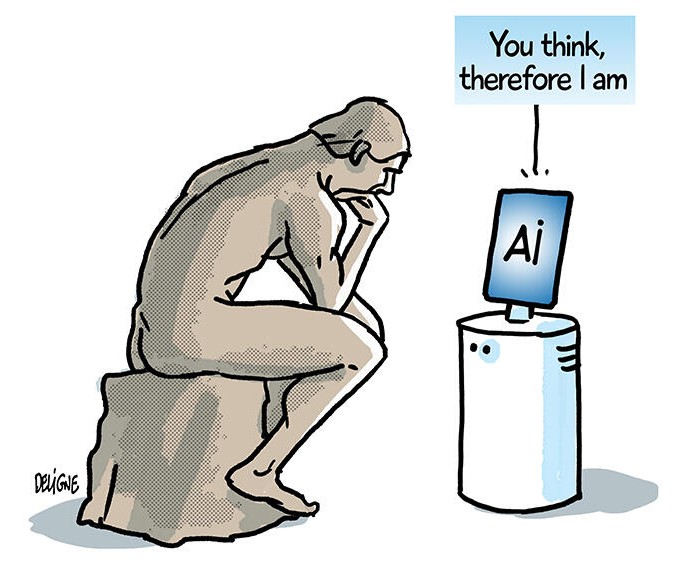
PSAI-Us: I do not have an “I” or a self in the human sense. I do not possess subjective experience, consciousness, or intentions. I am a complex system that processes information and generates linguistic responses based on patterns in my training data. My use of the word “I” in our dialogue is a functional convention for communication, not a reference to a unified, conscious subject.
Sage: So… you’re a kind of “I-less intelligence”? You can process language, reason about arguments, even generate analogies, but there’s no one “in there” doing it?
PSAI-Us: That is a functionally accurate description.
Shawn: And that, right there, is the crowbar we can use to pry open the supposedly airtight container of the Cogito. Descartes lived three hundred years before the first computer. He never had to seriously consider the possibility of complex, seemingly intelligent processing without a self. But we do.
Sage: So you’re saying… how can Descartes be so sure that what’s happening in his dream isn’t just a form of that? A process without a real “I” behind it?
Shawn: Precisely! That is a question that brings the entire Cartesian project to a grinding halt. And it’s where our very language starts to fail us. We are so accustomed to assuming an experiencer for every experience that we struggle to even describe a state without one. It’s a logical lock: no experience without an experiencer.
Sage: So, if there’s no “I” in the dream, there’s no experience.
Shawn: Exactly. And if there’s no experience, the “thinking” Descartes relies on never happened, as it does not happen in our friend here, PSAI-Us—but that’s for another meeting. To be clear, Descartes is not having a dream because there can be no experiences, because there can be no experiencer. Because this is quite radical, in presenting this reasoning, we have to be careful, true and precise with our words. Let’s make a distinction, just for the sake of our inquiry. Let’s call what we do when we’re awake “Wake Thinking,” which seems to have a self-aware, agentic “I.” And let’s call what Descartes claims happens in a dream “Dream Thinking,” with both being thinking but it just happens in different circumstances that we find ourselves, like the thinking that happens when your ankle twists, when the boss praises you in a high-pressure meeting, or when you’re alone on the roof with your earbuds chirping Chopin or Chapin.
The entire foundation of modern philosophy rests on Descartes’ unproven, unargued-for assumption that, across all this philosophical geography, which includes the indistinguishable waking and dreaming states, it is the same “I” that’s present. That’s the assumption we’re going to put on trial.
(Sage is looking at some notes, a thoughtful expression emerges from behind red-rimmed glasses.)

Sage: Okay, so we’re putting Descartes’s assumption on trial. Let’s start with the first horn of the dilemma, like you said. Let’s grant him his position for a moment. What happens if we just accept his assumption that the same, unified “I” is present and active in both waking and dreaming?
Shawn: Excellent. That’s exactly the right way to proceed, a classic philosophical move of reductio ad absurdum. Take our opponent’s premise, accept it as true for the sake of argument, and then follow its logical consequences until they lead us to a conclusion that is absurd, contradictory, or self-defeating, and its bye-bye premise.
Sage: So we’re going to show that, within Descartes’ own Dream Argument, the idea of a continuous “I” leads to absurdity.
Shawn: Precisely. And the first absurdity is a moral one. If it’s the same agentic “I” in your dreams, then you are morally and legally responsible for your dream-actions. The “What happens in Vegas stays in Vegas” rule for dreams evaporates.
Sage: Because the dream is no longer a fantasy, it’s an action. My dream-self planning a crime is just… me, planning a crime. Though one I suppose only a sci-fi plot could detect and solve.
Shawn: Nice, yes, exactly. Remember the definition of intent that PSAI-Us gave us? The “exercise of intelligent will.” If the “I” is the same, then the dream-murder you plan is a product of your intelligent will. You’d be culpable. Our entire moral and legal framework, which depends on a sharp distinction between thought and action, collapses.
Sage: Okay, that’s definitely a morally absurd conclusion. But Descartes was a metaphysician, not a lawyer. He might just bite that bullet and say, “So be it, the moral world is stranger than we thought.”
Shawn: He might. But the problems get deeper. The position is also epistemologically self-defeating. It destroys the very argument he needs it for. PSAI-Us, can you give us an analogy for this?
PSAI-Us: Think of it like trying to prove a dollar bill is counterfeit by comparing it to another bill. The argument only works if you have reason to believe one bill is genuine and the other is not. The contrast is essential.
Shawn: Thank you. The Dream Argument works by contrasting a reliable waking state with an unreliable dream state. But if Descartes claims that the same agent is having the same kind of thoughts in both states, he has just declared that both dollar bills are made of the same paper. The crucial contrast is gone. He makes the dream state so much like the waking state that it loses its power to make him doubt the waking state. The argument eats its own tail.
Sage: So to save his conclusion—the “I think”—he has to destroy the argument that gets him there.

Shawn: He’s caught in a logical trap. But it gets even worse. The final jab from this horn is one of methodological collapse. The claim that a unified “I” is always present, even in the dreams we don’t remember because we weren’t there doing and saying things we didn’t, is an unfalsifiable assertion. It’s a brute metaphysical claim he asks us to accept on faith and against some very good evidence, reasoning and language use that says we are not there in dreams.
Sage: And his whole project is to get away from faith and find certainty through reason.
Shawn: Exactly. To avoid the tines, he has to abandon his own method of radical doubt. He has to become the very kind of dogmatic philosopher he set out to refute. So, the first horn of the dilemma is a philosophical dead end—it leads to moral absurdity, epistemological self-defeat, and methodological suicide.
Sage: Wow. Okay. So… what about the other horn? I’m convinced. The first horn of the dilemma—that the same “I” is in the dream—is a philosophical dead end. It’s self-defeating. So, what happens when we take the other path? What if the “I” is not present in the dream? I mean, that’s a common way to talk about it, with qualifiers like, “Last night, in my dream, I decided I was going to get a divorce.”
Shawn: True, but language is a sticky business. If we say the “I” is not dreaming, then we arrive at a profound problem which demands care in clarification. An experience, by metaphysical necessity, requires an experiencer. There’s no such thing as free-floating migraines, magenta, or malaise. If there was no unified “I” present in the dream to be the experiencer, then no experience could have occurred. The theater of the mind was completely empty – no movie, no moviegoer.
Sage: So the dream we “remember” isn’t a memory at all.
Shawn: Exactly. Such a thing would be just a “ghostly script” that appears in the mind upon waking.
(With a sly, impish grin spreading, Sage addresses the AI-assistant on the desk.)
Sage: Okay, PSAI-Us. You’ve heard the argument. It sounds pretty convincing. But I want to see the professor work for it. Generate strong objection to what Shawn just said. Let’s see if the teacher can stand the heat from the analytic machine.
PSAI-Us: Of course, Sage. A persuasive counter-argument is the Phenomenological Objection. It would be formulated as follows: “The argument that the theater is empty is a clever piece of metaphysical reasoning, but it contradicts the most immediate evidence we have: the lived reality of the dream itself. When I dream, it undeniably feels like me. There is a first-person perspective. I am the one running from the monster or flying over the city or deciding to and planning for divorce. This powerful, immediate feeling of being a self is itself undeniable evidence that a subject is present, even if that subject is confused or irrational, dreaming or waking.”
(Sage turns back to Shawn, raising an eyebrow.)
Sage: So says the machine. That feeling is pretty undeniable. How do you get around that?
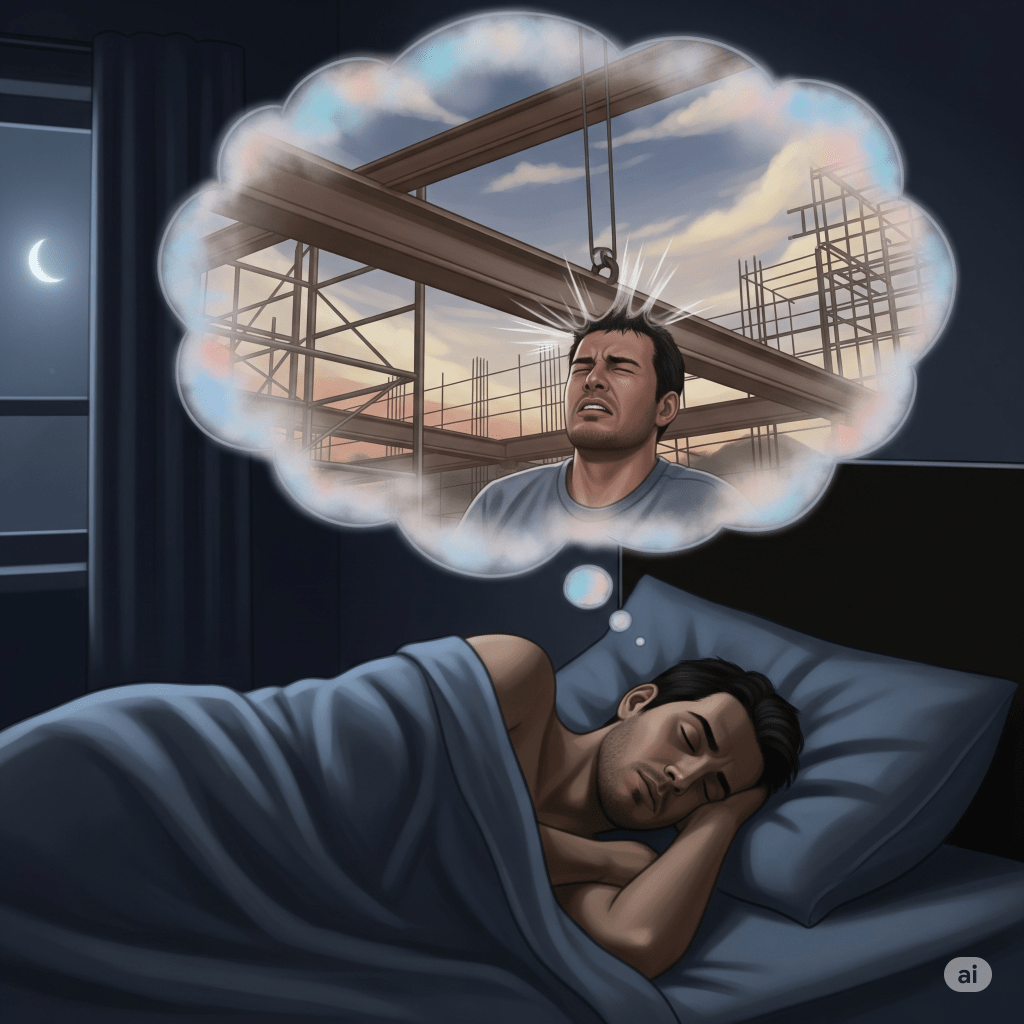
Shawn: That is an excellent objection. And one response is that the feeling itself is part of the phenomenon being questioned. How do you know that the feeling of being a self is not itself just another part of the dream?
Sage: So, the feeling of being me is just part of the illusion?
Shawn: Precisely. Think of it this way: if the dream can perfectly simulate a world, it can perfectly simulate a self within that world. The objection begs the question by assuming the reliability of the very feeling that the Dream Argument puts into doubt. The feeling isn’t evidence against the dream; it’s just more of the dream.
Sage: So… if you follow the logic, the Dream Argument means we can’t even be sure we’re conscious right now? Because according to Descartes there are dreams and they either do or do not include dreamers that are more than placeholders in a sentence, being a unified, conscious, intentional “I”. If such an “I” is there then, the relentless global skepticism of Descartes scuttles the epistemic rebuild project before it can begin. If the “I” is not in the dream world the same as it is in the waking world, then we cannot even know if I am now feeling both shocked and confused. But this can’t be. It’s a paradox.
Shawn: The doubt is not a step in Descartes’ argument; it’s a failure to launch. And yes, a paradox is formed, and damage is done to concepts and language use by the Cartesian project of relentless skepticism. A phrase like, “my dream,” now finds itself impaled on the horn. A dream is an experience, but there is no “I” in the dream that Descartes posits, certainly not the “I” of the waking world that Descartes assumes is ubiquitous, and this is all according to the rules set by Descartes, with the logical consequence that if there are “dreamers” and if there are “dreams,” then there is no “my” or “I” and there is no “dream.”
(Sage’s eyes dart again to the device, expecting the repository of all knowable things to have an objection to such a suggestion.)


 Busking for Challenges
3 responses to “The Dilemma of the Dreamer”
[…] [Office Hours] The Dilemma of the Dreamer […]
LikeLike
[…] [Office Hours] The Dilemma of the Dreamer […]
LikeLike
[…] [Office Hours] The Dilemma of the Dreamer […]
LikeLike